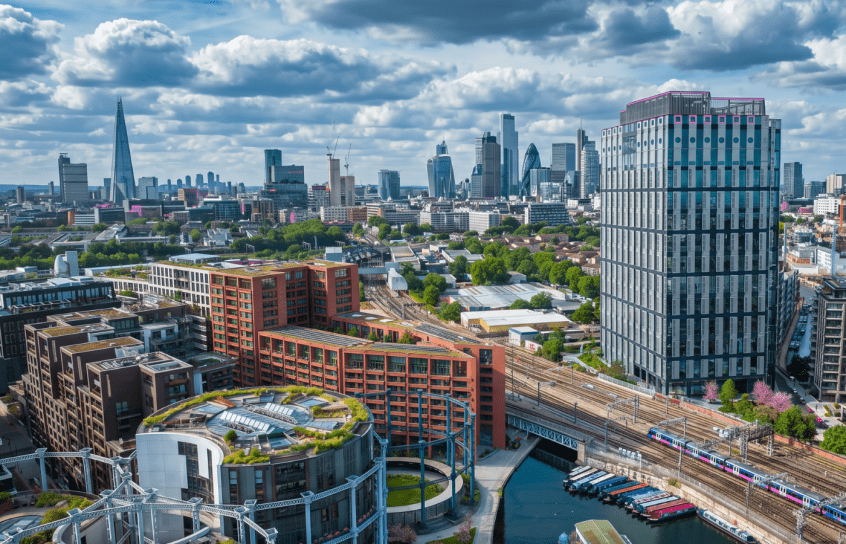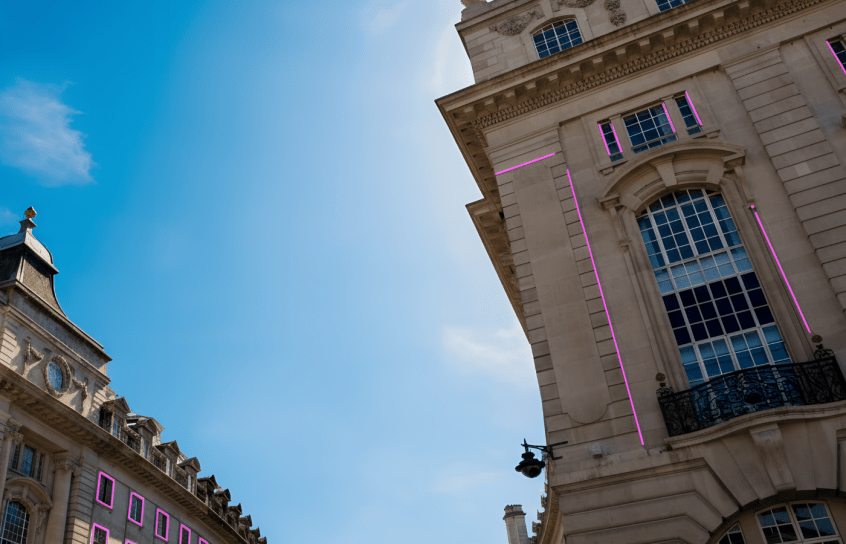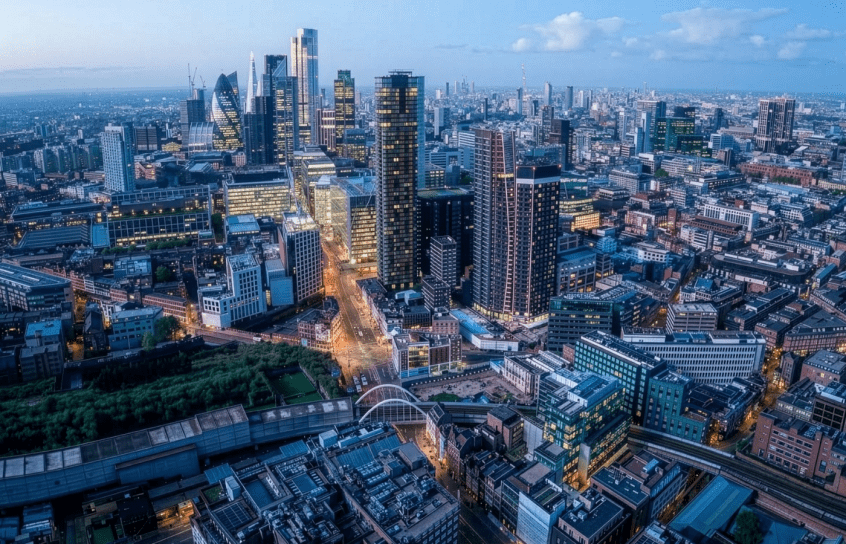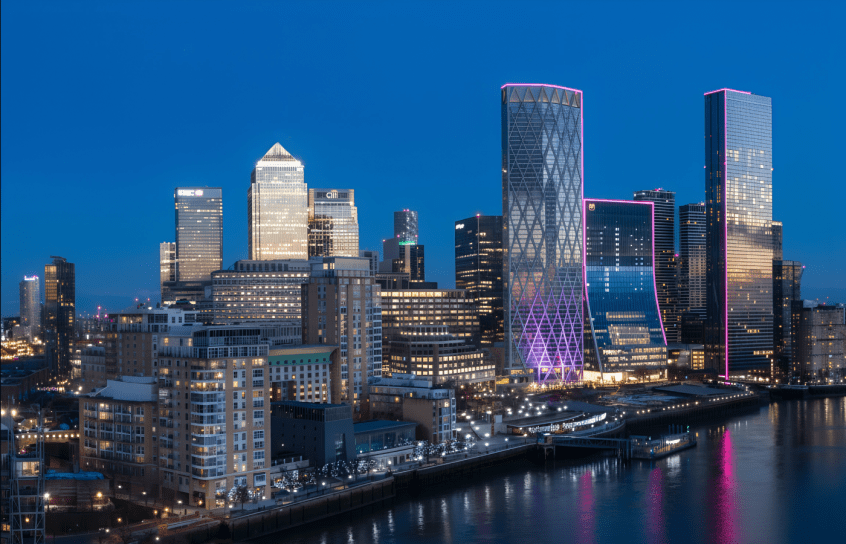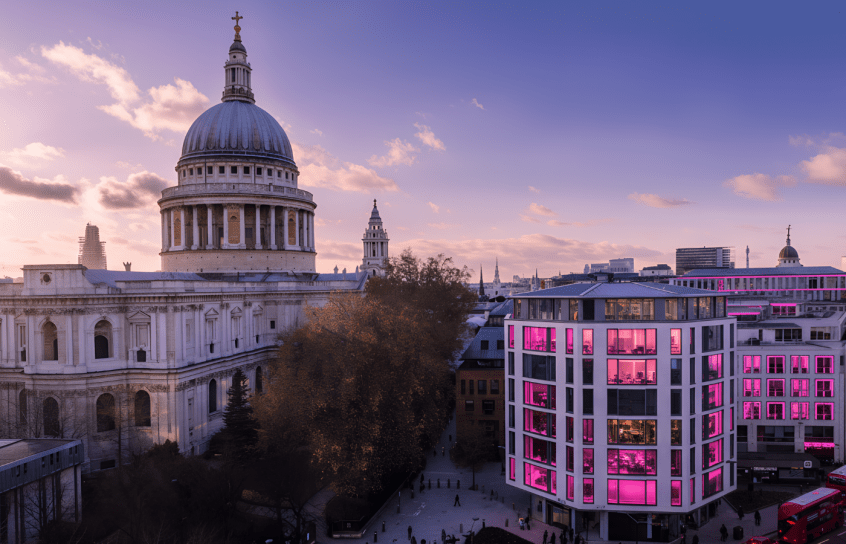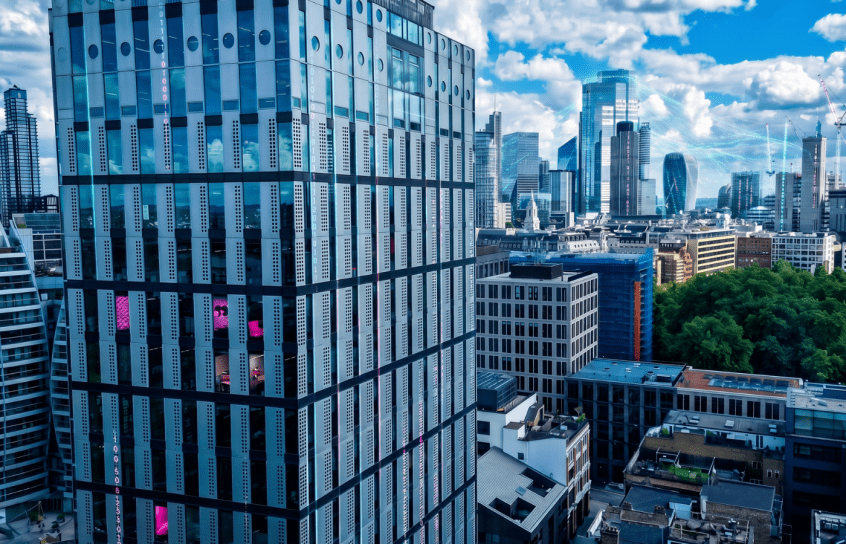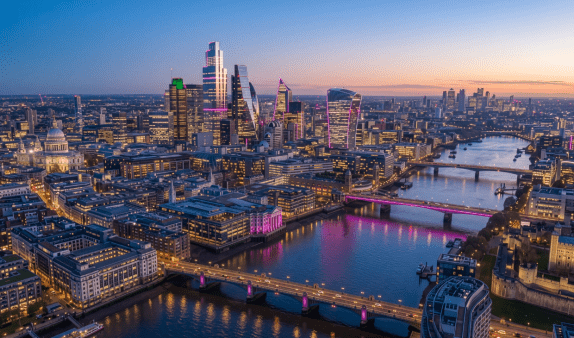
AI company registrations in the UK have jumped 1,321% since ChatGPT launched. The UK AI sector now has 5,800 companies and generated £23.9bn in revenue in 2024. In Shoreditch, London’s AI hub, Grade A space is being taken up faster than it can be built.
London is the AI capital of Europe
Shoreditch and King’s Cross are where its future is being built
With 47% of all UK AI-named tech firms based in London, every one of those businesses will face the same critical question: what does our office strategy look like as we scale?
For the most ambitious, the answer increasingly points to two clusters. Shoreditch and the City Fringe for companies that need to be inside London’s tech talent network while holding rents well below West End levels. And King’s Cross, where the Knowledge Quarter has become the address of choice for the world’s most consequential AI names. Google DeepMind, Meta, and Microsoft already anchor the area.
OpenAI has since taken 88,500 sq ft at Regent’s Quarter. Anthropic signed 158,000 sq ft at One Triton Square. According to CoStar, almost half of all AI lettings across London in April 2026 clustered in the King’s Cross and Euston area – a concentration that reflects both proximity to Cambridge and a deliberate cluster effect among firms competing for the same engineers.
Both zones are tightening fast. City tower vacancy averaged 2.9% in Q1 2026, with prime towers lower still. The firms moving now are not waiting for conditions to improve. They are moving because they understand what it costs to wait.
Luma AI, backed by NVIDIA and valued at $4 billion, opened its first international office in London in December 2025, with plans to hire 200 people by early 2027. These companies are not choosing serviced offices. They are making long-term commitments.
OpenAI at Regent’s Quarter and Anthropic at One Triton Square: Estates Gazette, June 2026. King’s Cross lettings share: CoStar, as reported May 2026. Luma AI: CNBC / Luma AI press release, December 2025.
Here are some of the recent headlines
7.4%
Central London vacancy rate in Q1 2026
Down from a 2025 peak of over 10%
78%
of Q1 2026 take-up was Grade A space
Flight to quality is accelerating
2.9m sq ft
Average City tower vacancy rate in Q1 2026
Prime towers lower still, at under 1%
34%
AI-led share of London’s tech take-up in 2025
The fastest-growing slice of the market
What’s driving demand
Unlike the previous wave of tech businesses that leaned into remote-first models, AI companies are driving a decisive return to premium, in-person collaboration.
Researchers, engineers, and model trainers need to test, iterate, and build together. The office is their infrastructure, and Shoreditch or Midtown are the infrastructure of choice.
Shoreditch sits at the centre of London’s AI ecosystem
The City Fringe, covering Shoreditch, Farringdon, and Clerkenwell, continues to see strong demand from the tech and AI sector. Grade A fitted rents run £60–£95 per sq ft, offering significant value against the West End’s £175 per sq ft prime while keeping firms inside the talent network that matters most to AI hiring.
SHB Real Estate, Q1 2026
Early-stage AI companies need agile real estate plans
According to Property Week (March 2026), AI firms are moving from flexible spaces to traditional offices of 20,000 to 30,000 sq ft within 18 to 24 months of starting up. Some companies are increasing their space by up to 10 times as they compete for top talent.
Property Week, March 2026
Structural change in AI-firm demand
Research from CBRE reported by BE News in April 2026 found that AI-led occupiers accounted for 34% of London’s tech sector take-up in 2025, up from just 4% in 2015. AI-led companies have taken around 1.5m sq ft of traditional office space across Central London since 2015, making up 11% of total tech sector take-up over the period, and more than half of that space has been taken since the start of 2022.
Reported by BE News, April 2026
The occupiers who move are committing early
Q1 2026 saw 2.5m sq ft transacted across Central London, close to the five-year quarterly average. Grade A space accounted for 78% of all take-up, with pre-letting hitting its highest Q1 level on record as occupiers secured the best buildings before they reached the open market.
SHB Real Estate, Q1 2026

Real estate to facilitate scale
Most AI scale-ups approach their first major office search without a dedicated real estate team. That’s where deals go wrong, not on the headline rent, but in the detail: break clauses, capital contributions, fit-out obligations, and the market intelligence to know whether the deal in front of you is actually the best one available.
Our proprietary data platforms and market intelligence give clients a genuine competitive advantage. We don’t estimate market conditions. We measure them. In 2025, we saved clients £32.2m across relocations, renewals and negotiations.
Our 360° model means we stay with you from the search through to fit-out and ongoing management, so nothing falls between the gaps.
A recent acquisition for a fast-scaling AI company demonstrates exactly what that means in practice: 27,000 sq ft on a 15-year lease in Shoreditch. In a sub-market where Grade A space is scarce, demand is intensifying, and most tech firms default to short-term flexibility, a long-term commitment of that scale demands specialist guidance. The result was a deal structured to support a decade and a half of growth, backed by data, extensively negotiated and delivered without friction.
SHB’s head of agency, Andy Guntrip, notes, “A 15-year lease from a fast-scaling AI company in Shoreditch is a statement of intent, and the kind of move that only happens with the right intelligence behind it.”
This isn’t a short-term trend. BE News reported in April 2026 that AI-led office take-up in London could reach 4m sq ft by 2033, building on the 1.5m sq ft already taken since 2015.
SHB’s strategic support
If you’re scaling an AI or tech business and starting to think about what your next office looks like – the window to act with confidence is narrowing. Supply continues to fall. Competition for the best Shoreditch and City Fringe buildings is only increasing. The firms that move decisively now will define where London’s AI ecosystem is headquartered for the next decade.